
Modern LED Lighting Pole: Design, Height, Features and Project Selection Guide
Written by the Surya Traders team. Category: Modern LED Lighting Poles.
A modern LED lighting pole is more than a vertical steel support. Its height, profile, arm arrangement, mounting detail, material, surface protection and compatibility with the LED luminaire all influence how a finished lighting installation performs. Choosing the pole first and trying to fit the rest of the system around it can create avoidable problems in illumination, appearance, installation and maintenance.
This guide explains how to evaluate a Modern LED Lighting Pole for roads, campuses, commercial developments, parking areas, residential projects and other outdoor spaces. The goal is to help project owners, contractors, consultants and purchasing teams compare the important specifications before placing an order.
1. What Makes a Modern LED Lighting Pole Different?
Modern LED lighting poles are designed around two requirements that must work together: a clean contemporary appearance and dependable structural support for the luminaire. Unlike a pole selected only by nominal height, a modern design should be considered as a complete system consisting of the shaft, arm or bracket, luminaire mounting point, base arrangement and foundation interface.
A well-planned pole can give a project a consistent visual language while keeping the LED fixture at the intended mounting height and orientation. For a product overview, see our Modern LED Lighting Pole page. It is useful to review the available configurations there before finalising a project specification.
For large installations, the project brief should identify the required mounting height, luminaire weight, projected area, arm reach, environmental exposure and expected maintenance method. These details give the manufacturer a much clearer basis for selecting the pole configuration.
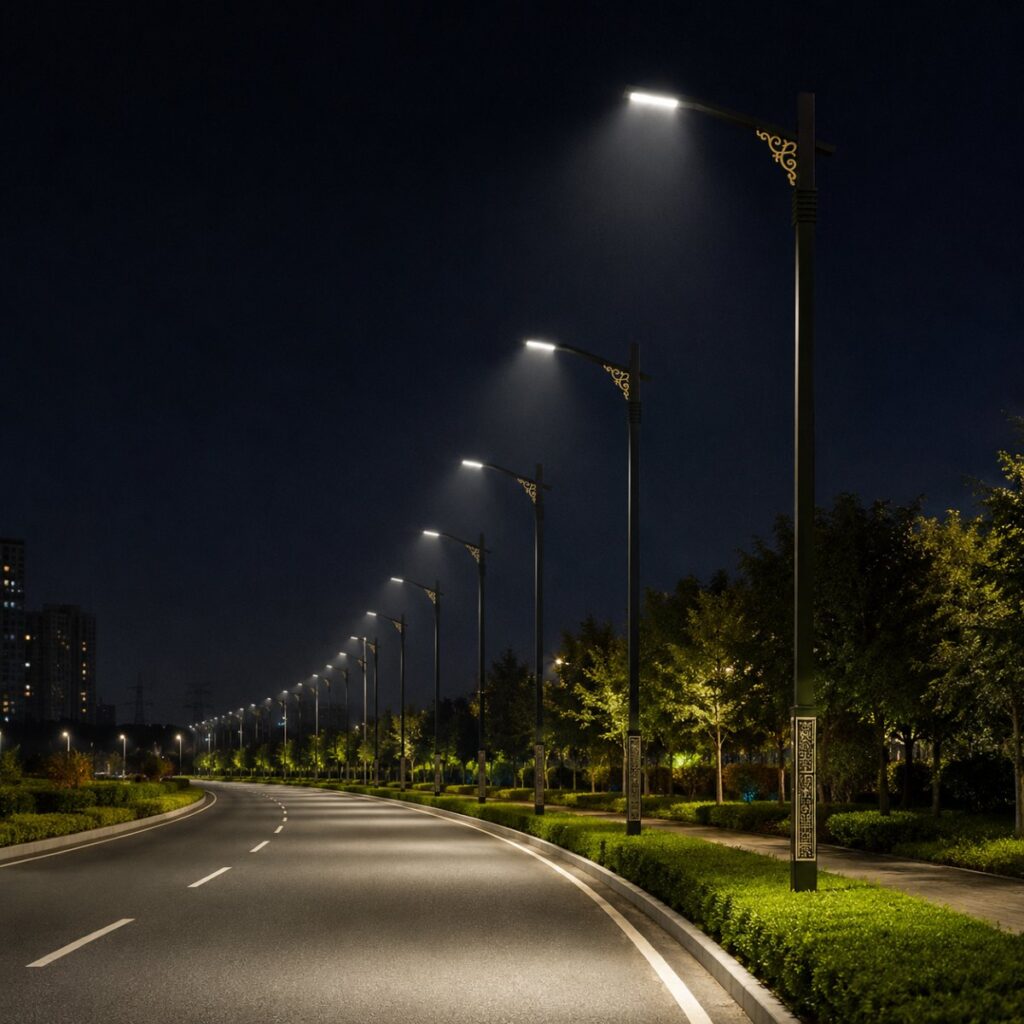
LED technology has also changed what project teams expect from outdoor lighting. The pole should accommodate the selected luminaire rather than simply looking attractive in isolation. Government programmes and technical guidance have also placed emphasis on efficient street lighting and appropriate LED-based systems; the Ministry of Power’s Street Lighting National Programme information provides useful background on India’s large-scale LED street-lighting transition.
2. How to Select the Correct Pole Height
Height should be selected from the lighting layout, not from appearance alone. A taller pole may provide a wider coverage area, but the final result depends on luminaire optics, road width, pole spacing, mounting position and the required illumination level. A shorter pole can suit pedestrian-scale or compact areas, while higher poles may be appropriate where wider coverage is required.
Before ordering, establish the finished mounting height above ground and then check whether the proposed arm and luminaire geometry achieves the intended aiming angle. Also confirm whether the pole will be installed on a road edge, central verge, parking area, campus path or another location. These conditions can change the required height and spacing.
3. Modern LED Lighting Pole Height & Project Selection Table
The following planning table is a starting point rather than a universal design rule. Final height and spacing should be confirmed from the project’s lighting calculations, road geometry, luminaire photometry, wind conditions and structural requirements.
| Pole height | Typical planning context | Key checks |
|---|---|---|
| 4–6 m | Pathways, compact campuses, parking | Mounting height, optics and spacing |
| 7–9 m | Urban and internal roads | Road width, arm reach, wind and foundation |
| 10–12 m | Wider corridors and higher mounting requirements | Structural calculation, wind load and maintenance access |
Important: these ranges are for project planning, not a promise that one height will suit every site. A proper lighting layout should determine the final pole height and spacing. The same 8 m pole can produce very different results when the luminaire, optics, road width or spacing changes.
4. Choose the Pole Profile and Arm Arrangement Carefully
The profile is one of the most visible parts of a modern LED lighting pole. Straight shafts, tapered forms and purpose-designed profiles can create different architectural impressions. The correct choice should balance appearance with fabrication, structural requirements and the way the luminaire is mounted.
Arm arrangement is equally important. A single-arm configuration can direct light toward one carriageway or defined area, while a double-arm arrangement may serve two directions from one pole where the lighting layout permits it. The arm should be coordinated with the luminaire dimensions, mounting spigot, outreach and aiming requirements.
| Configuration | Best suited to | Checks |
|---|---|---|
| Clean straight profile | Contemporary roads, campuses and commercial areas | Shaft, finish, base and luminaire mounting |
| Single arm | One-sided lighting | Outreach, tilt, spigot and wind area |
| Double arm | Two-direction lighting | Combined load, balance and structural design |
Do not specify an arm only by saying “single” or “double.” The quotation should state outreach, mounting arrangement, luminaire interface and material or fabrication requirements. If the project uses a proprietary LED luminaire, provide its mounting dimensions and weight so the pole can be matched accurately.
| Quotation item | Specify clearly |
|---|---|
| Pole | Height, profile, material, section details and quantity |
| Arm | Single/double, outreach, angle and luminaire interface |
| Protection | Surface treatment, coating requirement and finish |
| Documents | Drawing, material/test documentation and project records |
A useful procurement principle is to specify the complete pole-and-luminaire interface. This avoids a situation where the pole is structurally adequate but the selected fixture cannot be mounted at the required angle or spigot size.
5. Select Material, Thickness and Surface Protection
Mild steel is commonly used for fabricated lighting poles because it offers flexibility in fabrication and can be engineered for different heights and configurations. For projects where corrosion exposure is important, the surface-protection system should be specified clearly rather than relying on a general statement such as “rust proof.”
Thickness should be treated as an engineering parameter, not a marketing number. The required section depends on pole geometry, height, arm arrangement, luminaire load, wind exposure and the design assumptions used for the project. A heavier-looking pole is not automatically the correct pole, and a thinner pole is not automatically inadequate.
For projects requiring a formal material or product specification, check the relevant BIS documentation and laboratory information. The BIS laboratory/UTRF information is a useful official reference point when verifying applicable Indian standards and testing routes.
6. Check LED Luminaire Compatibility Before Ordering
The LED luminaire is the component that actually produces the light, so the pole must be designed around its mounting requirements. Before confirming a modern LED lighting pole, record the luminaire weight, mounting spigot diameter, mounting orientation, outreach requirement, cable entry arrangement and any manufacturer-specific fitting details.
- Confirm mounting interface. The spigot or bracket must match the luminaire.
- Confirm luminaire weight. Include the complete installed fixture and accessories.
- Check projected area. Wind pressure acts on the fixture as well as the pole.
- Confirm aiming angle. The arm geometry should allow the intended beam direction.
- Plan cable routing. Provide suitable access and entry details without compromising the pole.
For a wider comparison of lighting pole products, you can also visit the lighting pole products section on the website.
7. Consider Foundation, Wind Exposure and Maintenance
A modern LED lighting pole is only as reliable as the complete installation around it. The foundation, anchor arrangement or planting detail must suit the pole configuration and site conditions. Soil, wind exposure, pole height, luminaire area and arm projection all affect the structural demand.
Do not use a generic foundation dimension for every project. The foundation should be checked against the actual pole, soil conditions and design loads. For an engineered project, provide the manufacturer or structural consultant with the site location, pole height, luminaire details, arm geometry and foundation assumptions.
Maintenance should also be considered before the pole is ordered. The luminaire must be accessible for cleaning, inspection and replacement. Cable access, door position, earthing provisions and fasteners should be practical for the installation team.
| Specification | What to provide | Why it matters |
|---|---|---|
| Pole height | Required mounting height above finished ground | Coverage, appearance and structural demand |
| Luminaire | Weight, spigot, dimensions and projected area | Mounting compatibility and wind load |
| Arm | Single/double, outreach and mounting geometry | Light direction, balance and structural loading |
| Foundation | Soil/site conditions and approved design | Safe transfer of loads into the ground |
For electrical and product requirements, use the applicable Indian standard for the selected luminaire and verify the manufacturer’s test documentation. The BIS laboratory scope information can help identify testing information for relevant lighting equipment. Standards should be checked against the exact product and edition applicable to the project.
8. Compare Specifications Before Ordering Your Modern LED Lighting Pole
A strong enquiry should allow every supplier to price the same technical requirement. Instead of sending only “10 m modern LED pole,” provide a concise project specification covering height, shaft profile, material, arm arrangement, luminaire interface, finish, foundation/base requirement, quantity and delivery location.
Ask for a drawing or dimensional schedule where the project requires it. The quotation should make clear what is included: pole shaft, arm, base plate or planting arrangement, access door, earthing provision, fasteners, surface treatment and any supplied accessories.
For structural or public-infrastructure projects, request the applicable material and test documentation. This makes technical comparison easier and reduces the risk of comparing a basic pole against a differently engineered specification.
9. Frequently Asked Questions About Modern LED Lighting Poles
Ready to discuss a project? Share the required pole height, quantity, luminaire details, arm arrangement, installation location and delivery requirement. You can send your enquiry through the Surya Traders contact page for a project-specific quotation.
When the technical details are clear, the manufacturer can recommend a configuration that is better matched to the actual lighting application rather than simply supplying a generic pole.
What is a modern LED lighting pole?
A modern LED lighting pole is a contemporary outdoor lighting support designed to carry LED luminaires while providing an appropriate height, mounting arrangement, structural configuration and finished appearance for the project.
What height is suitable for a modern LED lighting pole?
There is no single height for every project. The correct height depends on the lighting layout, road or area width, luminaire optics, pole spacing, wind exposure and required mounting height.
Can a modern LED lighting pole have a single or double arm?
Yes. Single-arm and double-arm arrangements can both be used where the lighting layout supports them. The arm geometry and combined luminaire load should be checked as part of the pole design.
What information should I provide when requesting a quotation?
Provide pole height, quantity, installation location, luminaire weight and mounting details, arm arrangement, finish or corrosion-protection requirement, foundation information and delivery location.
How do I choose the right modern LED lighting pole for a project?
Start with the lighting layout and luminaire requirements, then confirm height, profile, arm arrangement, material, structural loading, surface protection, foundation and maintenance access before ordering.
October 21, 2026
October 21, 2026
October 19, 2026
October 19, 2026
October 19, 2026
October 19, 2026