
Decorative Lighting Pole in Bhopal: How to Choose Poles for Lakefronts, Parks, Townships and Commercial Spaces
Written by the Surya Traders team. Category: Decorative Light Pole.
Bhopal is often called the City of Lakes, and much of its public life happens after sunset: evening walks beside the water, family visits to parks, weddings in banquet lawns and shopping in busy commercial lanes. In these places a lighting pole is not only a support for a lamp. It is also part of how the space looks and feels, which is why decorative lighting pole projects need more thought than a plain road installation.
This guide is written for architects, landscape consultants, township developers, hotel and campus managers and contractors planning decorative lighting in Bhopal. It covers where decorative poles are used, how to match style to the site, how to think about height and spacing, how to control glare, what Bhopal’s weather means for the finish, and how to prepare an enquiry. If you are ready to compare suppliers, see our page on decorative lighting pole manufacturing in Bhopal.
Quick answer: decide the mood and the viewing distance first, fix height and spacing from a lighting layout, specify the finish in writing, and send every manufacturer the same drawing and brief.
1. Why Decorative Poles Matter in a City Like Bhopal
According to the Bhopal article on Wikipedia, the city is known as the City of Lakes, with the Upper Lake dating back to the eleventh century and the smaller Lower Lake beside it. Visitors and residents spend time on promenades, in parks and around heritage areas, and the quality of lighting in these places shapes whether people feel comfortable staying after dark.
A plain pole does its job but disappears into the background. A decorative pole is chosen to be seen. It has a shaped shaft, a bracket or crown and a lantern or luminaire that together give the place a character: classic, contemporary or somewhere in between. The same pole also has to carry weight, resist the weather and stay safe for years, so appearance and engineering must be planned together.
For a project owner, three questions come first. What mood should the space have at night? From how far will people see the pole? And who will maintain it? Answering these before you shortlist a design saves time later, because the style, the height and the finish all follow from them. Our separate decorative lighting pole design guide goes deeper into visual character, and this article concentrates on planning and buying in Bhopal.
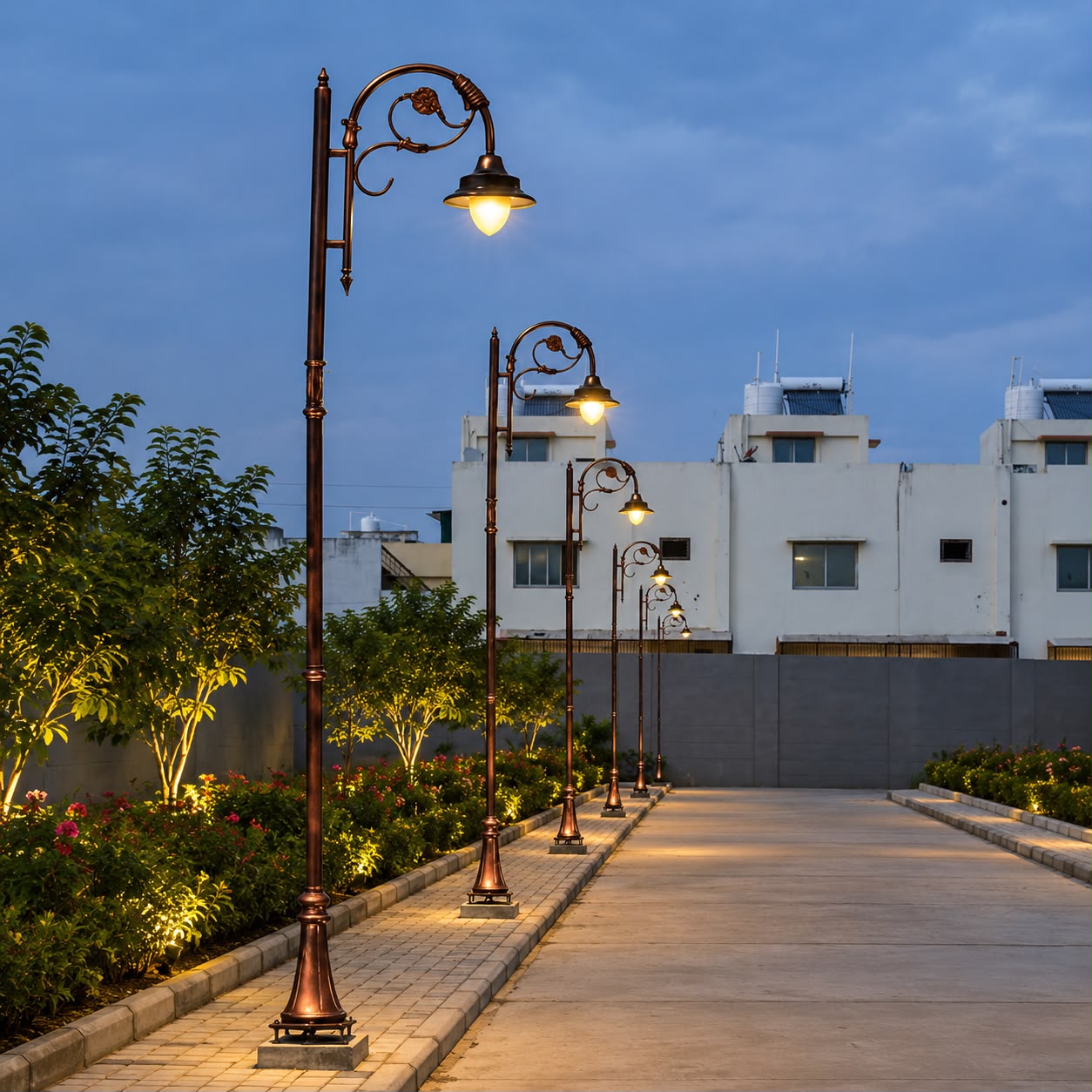
2. Where Decorative Poles Are Used Across Bhopal
Decorative poles suit places where people walk, linger and look around, rather than roads where vehicles pass quickly. In Bhopal the common settings include lakeside walkways, public parks, residential townships, hotels and banquet venues, hospital and college campuses, temple and heritage precincts, and commercial plazas.
The table lists the main settings, what the poles are expected to do and what to check first. It is a planning aid and does not replace a site drawing.
| Setting | Role of the Pole | Check First |
|---|---|---|
| Lakeside walkways and promenades | Welcoming evening light for walkers and families | Wind exposure, damp ground and glare toward the water |
| Public parks and gardens | Soft, even lighting along paths and play areas | Pole scale, tree cover and vandal resistance |
| Residential townships | A consistent look along internal roads and entrances | One design language, spacing and easy maintenance |
| Hotels, banquets and resorts | Atmosphere at entrances, lawns and drives | Matching the architecture and controlling glare |
| Campuses and hospitals | Safe, calm lighting between buildings | Cable routing, visitor safety and future additions |
| Commercial plazas and heritage precincts | Character and visibility for shops and landmarks | Design approval, finish colour and luminaire weight |
Do not copy one design across every setting. A lakeside promenade, a quiet township lane and a commercial plaza have different viewing distances and different activity at night, so a pole that suits one can look out of place in another. Group the project into zones and choose one design for each zone.
3. Matching Pole Style to the Site
Style is easiest to judge when you look at the surroundings. Classic designs with curved brackets and lantern-style heads fit heritage areas, banquet lawns and traditional townships. Cleaner, simpler shafts suit modern offices, hospitals and campuses. Hotels and resorts often want a more distinctive look that matches their entrance and landscape.
Three habits help you avoid a mismatch:
- Photograph the site and its buildings, then compare the shortlisted pole drawings against those photographs
- Check the pole from the walking line, not only from a front-on catalogue picture
- Keep to one design language within a zone, so that the lighting looks planned rather than patched together
Think also about daytime appearance. Many visitors see the pole in daylight far more often than at night, so the shape of the bracket, the finish and the way the shaft meets the base matter just as much as the lantern. A pole that looks good only when lit is a poor choice for a public space.
Ask the manufacturer for a dimensioned drawing that shows the shaft, bracket, lantern seat and base, not just a rendered picture. Surya Traders lists its range on the decorative lighting pole page, and a drawing for a specific design can be requested with your enquiry.
4. Height, Spacing and Lantern Size at Human Scale
Decorative poles are usually shorter than road poles, because people see them at close range. A pole that is too tall feels cold and throws light over the heads of walkers. A pole that is too short can create glare at eye level and leave patches between fittings. The right height depends on the width of the walkway, the size of the lantern and the amount of light needed, and a lighting layout from the luminaire supplier is the reliable way to confirm it.
Our decorative range is listed in heights of roughly 3 m to 12 m, so there is room to choose, but taller is not better. For narrow walkways and courtyards a smaller scale is often more comfortable. For larger plazas and entrance drives a taller pole can give wider coverage with fewer poles.
Spacing needs the same care. Poles placed too far apart leave dark gaps, and poles placed too close together waste money and energy. Mark every pole position on the layout drawing, then check the result against the luminaire maker’s recommended spacing for the chosen height. Keep in mind that tree canopy, steps and benches can block light, so walk the site before you finalise the layout.
Finally, ask whether the quoted length is the overall length of the pole or the height above ground. A pole that is planted loses the buried part, while one fixed to a base plate is almost fully visible. This one question avoids many disputes about quotations.
5. Light Quality: Glare, Colour and Responsible Lighting
A beautiful pole with harsh light spoils the place it is meant to improve. Glare tires the eye, hides faces and can disturb nearby homes and hotel rooms. Good decorative lighting directs light to the surface that needs it and keeps the source out of the line of sight.
DarkSky International summarises five principles for responsible outdoor lighting: light should be useful, targeted, kept at a low level, controlled, and warm in colour. These ideas translate easily into a decorative project:
- Choose a luminaire that shields the source and directs light downward
- Use the lowest brightness that suits the task, especially near homes and water
- Plan timers or dimming, so lights are not at full output all night
- Prefer a warm colour appearance for walkways and gardens, which also flatters trees and stone
Near water, bright fittings reflect on the surface and can dazzle people on the opposite bank, so keep lakeside lighting modest and well shielded. Around homes and hotel rooms, check that the light does not fall into windows. A short mock-up with one pole and one lantern on site, viewed at night, will tell you more than any catalogue.
The luminaire and the pole must be planned together. The weight, size and wind area of the fitting affect the bracket and the base, so share the luminaire details at the enquiry stage instead of after the order.
6. Finish and Corrosion Protection for Bhopal's Weather
Bhopal has a hot summer in which highs regularly pass 40 °C in May, followed by a monsoon that runs from late June to late September, as the Wikipedia climate summary describes. Heat ages paint, and months of rain and damp ground attack the base of a pole, the door opening and every weld or bolt hole. A decorative pole also has more joints and details than a plain one, which gives water more places to collect.
Settle these points in writing before you place an order:
- The coating system, such as hot-dip galvanizing followed by powder coating or paint, and the thickness of each layer
- How the zinc coating is applied and checked. The Bureau of Indian Standards specification IS 4759 covers hot-dip zinc coatings on structural steel, so ask whether it is the reference
- The colour and finish, given as a specific reference rather than a general word
- How welds, cut ends and drilled holes are protected
- The treatment of the base and any buried portion
Maintenance is part of the finish decision. Decide who will clean the lanterns, check the door and fittings, and touch up the coating, and how often. A decorative pole in a public place will collect dust, bird droppings and the occasional knock, and a simple annual check keeps small problems from becoming expensive ones.
Inspect every pole on delivery for scratches, dents and damaged coating, and repair small marks before installation. Early attention costs very little compared with replacing a pole after a few monsoons.
7. Foundations, Cable Entry and Installation
The foundation depends on pole height, the weight of the lantern and arms, wind exposure and soil. Open lakeside areas can be more exposed than a sheltered courtyard. The supplier should provide the foundation drawing, and the project engineer should approve it before work starts.
Good planning on site includes:
- Marking pole positions on the layout drawing before excavation begins
- Using the supplier’s template for anchor bolts so that bolt positions are accurate
- Planning the underground cable route and the entry point at the base before the foundation is cast
- Providing earthing where the electrical design requires it
- Keeping every pole plumb, because a crooked row of decorative poles is very noticeable
Think about access for later work. A lantern that can only be reached with a crane in a crowded plaza is difficult to service. Ask the supplier how the luminaire is fixed, how the pole door opens and whether a standard ladder or lift will reach the fitting, so that routine repairs stay simple.
Decorative poles are often installed in finished landscapes, so protect paving, lawns and planting during erection, and agree who is responsible for making good any damage. Keep a written record of what was agreed between the supplier, the contractor and the engineer.
8. Choosing a Decorative Lighting Pole Manufacturer in Bhopal
The right manufacturer is the one who can match your drawing and prove it, not simply the one with the lowest price. Ask each supplier the same questions: what the pole is made of, how it is coated, what drawings and inspection records come with it, how long dispatch takes and who will answer questions during installation. A local manufacturer can also visit the site and check measurements before fabrication begins.
Surya Traders is based in Bhopal, and our page on decorative lighting pole manufacturing in Bhopal describes what we make for local projects. You can see the full range on the decorative lighting pole page and read more about the company on our About page.
Send every supplier the same written enquiry so that quotations can be compared fairly. The table lists the details a manufacturer needs.
| Detail to Share | Why It Matters |
|---|---|
| Site photographs and layout drawing | Shows the setting, walkway width and where each pole stands |
| Design reference or sketch | Lets the manufacturer match the style you want |
| Required height | State whether it is height above ground or overall pole length |
| Number of poles and arm configuration | Lets the supplier quote the quantity and check the layout |
| Luminaire type, weight and mounting | Affects the bracket, the shaft and the foundation |
| Finish and colour reference | Fixes the coating system and the final appearance |
| Base type | Base plate or planted pole changes the foundation work |
| Delivery location and timeline | Needed for pricing, transport and project scheduling |
When the quotations arrive, compare like with like. Check the height basis, the drawing, the coating system and the delivery terms before you look at the price. A quotation that leaves these out may be cheaper only because it covers less.
Need the right lighting pole for your project?
Share your required height, pole design, arm configuration and project application with Surya Traders for a suitable quotation.
Contact Surya Traders with your site details and we will help you take the next step.
Related Blogs
October 21, 2026
October 21, 2026
October 19, 2026
October 19, 2026
October 19, 2026
October 19, 2026
Frequently Asked Questions
1. What height of decorative lighting pole is common for parks and walkways in Bhopal?
Walkways and courtyards often use smaller poles, while larger plazas and entrance drives use taller ones. The right height depends on walkway width, lantern size and the lighting layout, so confirm it before ordering.
2. Can a decorative pole be made to match a specific design?
Yes, designs can be discussed against your drawing. Share a sketch or reference picture with your enquiry and ask for a dimensioned drawing before approval.
3. Do decorative poles need special corrosion protection in Bhopal?
The long monsoon and damp ground make a good coating important. Ask for the coating system and thickness in writing and check that the base is protected.
4. Can any luminaire be fitted to any decorative pole?
No. The weight, size and mounting of the fitting affect the bracket, the shaft and the foundation. Share the luminaire details when you ask for a quotation.
5. Should I choose a local manufacturer in Bhopal?
A local manufacturer can visit the site, check measurements and respond quickly during installation. Compare drawings, coating details and inspection records as well as price.