
Street Light Pole in Bhopal: How to Plan, Specify and Buy for Roads, Colonies and Industrial Areas
Written by the Surya Traders team. Category: Street Light Pole.
Choosing a street light pole in Bhopal is not the same as choosing one for a coastal town or a desert highway. The city has hot summers, a heavy monsoon, sudden thunderstorm winds and a mix of projects that runs from municipal roads to private colonies, campuses and industrial estates. A pole that suits one of these conditions can be the wrong choice for another.
This guide explains how to plan a street light pole project in Bhopal, from the first site drawing to the quotation request. It covers where poles are used, how to choose height and arm layout, what local weather means for wind load and corrosion, how to plan foundations and cable entry, how LED luminaires and public programmes fit in, and how to compare local suppliers. It is written for contractors, electrical consultants, housing societies, facility managers and procurement teams. If you are already comparing suppliers, our page on street light pole manufacturer in Bhopal shows what we offer for local projects.
Quick answer: fix the road and site conditions first, set height and spacing from a lighting layout, ask for coating and foundation details in writing, and send every supplier the same enquiry.
1. Why Bhopal Projects Need Their Own Street Lighting Plan
Bhopal is the capital of Madhya Pradesh and a city of lakes and low hills, so road gradients, curves and junctions vary far more than on a flat grid layout. Growth has pushed new colonies, commercial strips and industrial areas outward, and each of them needs lighting that suits its own traffic, its own layout and its own maintenance arrangements.
Public road lighting in the city is handled by the Bhopal Municipal Corporation. A report from September 2026 put the city’s street lights at about 70,000, including around 20,000 installed under the Smart City project, and described plans for central control panels that would switch lights on and off automatically and raise an alert when a fitting fails. For anyone supplying or specifying poles, the message is practical: poles should leave room for cable entry, control equipment and later changes to the luminaire, because the way street lights are monitored and maintained is changing.
Private projects follow different rules. Housing societies, campuses and industrial estates usually plan, buy and maintain their own lighting, so the owner has to make the technical decisions. In both cases, confirm the lighting requirements with the authority or client concerned before you freeze the pole specification, because changing a specification after fabrication starts is slow and expensive.
A short written brief helps every later step. It should state the road type, the target light level agreed with the client, the pole height and design, the luminaire to be fitted, the quantity, and the delivery location. Suppliers can then quote against the same facts, and your team can check each quotation against the brief instead of reading between the lines.
2. Where Street Light Poles Are Used Around Bhopal
Street light poles in Bhopal serve very different settings. Main roads such as the corridors along Hoshangabad Road, Raisen Road and Kolar Road carry heavy mixed traffic and often have medians. Residential colonies need quieter lighting along internal lanes. Industrial areas such as Govindpura and Mandideep need poles that can carry heavier luminaires and survive truck traffic. Campuses, hospitals and approach roads sit somewhere between these.
The table shows the first decision and the main concern for each project type. It is a planning aid, not a design.
| Project Type | First Decision | Main Concern |
|---|---|---|
| Main city roads and divided roads | Height, arm layout and spacing | Even light on both carriageways, median fixing, impact risk from vehicles |
| Residential colonies and societies | Height and number of poles per lane | Glare into homes, tree cover, easy maintenance |
| Industrial estates | Pole strength for heavier luminaires | Truck traffic, dust and higher fitting weight |
| Campuses and hospital approaches | Layout and consistent appearance | Cable routing, future additions, visitor safety |
| Bypass and highway approaches | Height and wind load basis | Open exposure, junction visibility, foundation size |
Treat each project type as a separate package. One tender that mixes a median-lit main road with an internal colony lane usually ends up with a pole that fits neither well, so group the work by use and select one pole specification for each group.
3. Choosing Pole Height, Arms and Layout
Height, arm length and spacing are decided together. A taller pole spreads light over a wider area but delivers less of it to the road surface and raises the risk of glare. A shorter pole gives closer control but needs more poles for the same length of road. The carriageway width, the luminaire and the required light level set the right balance, and a lighting layout from the luminaire maker or a designer is the reliable way to confirm it.
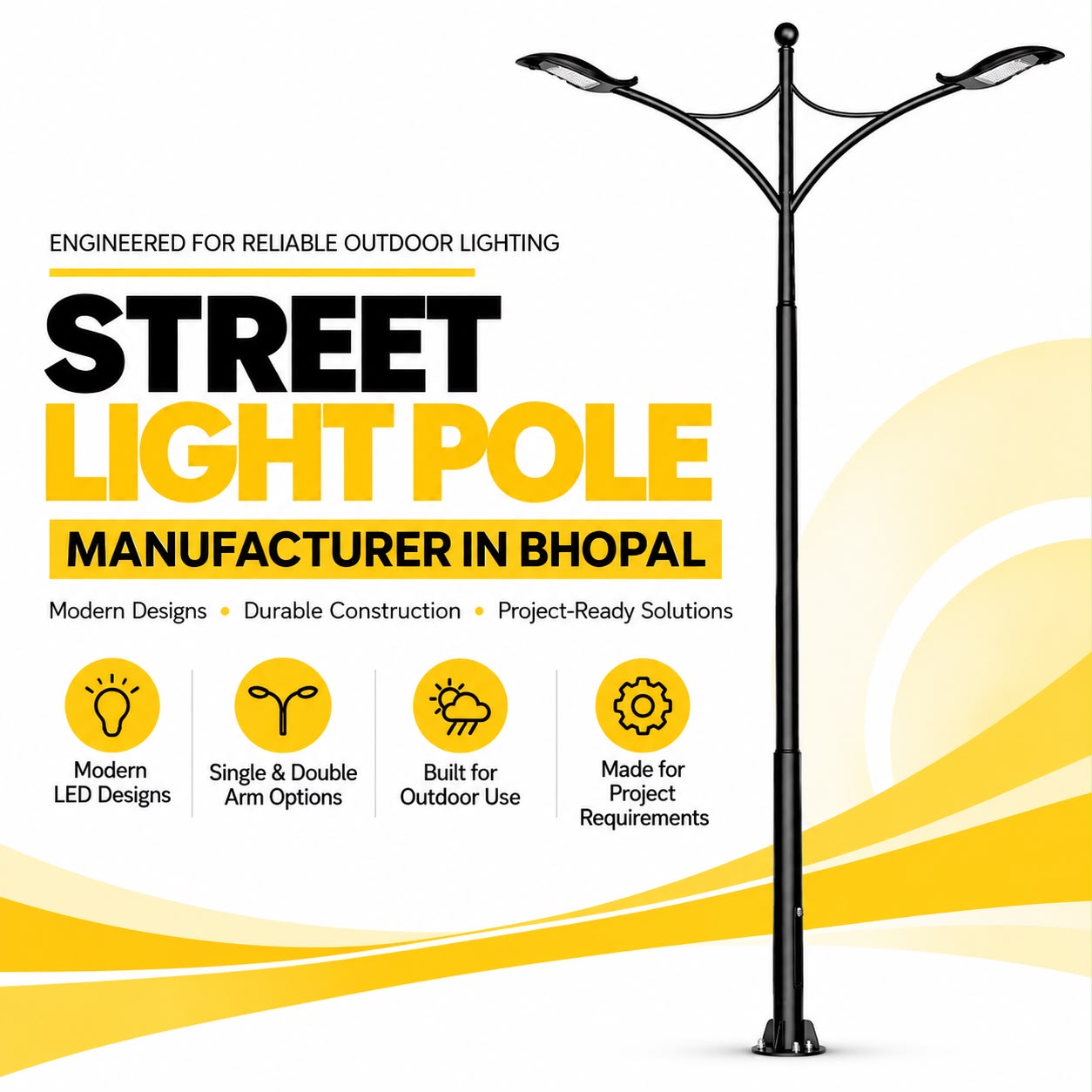
Layout follows the road. A single-arm pole on one side suits a narrow lane. Poles on both sides, either staggered or opposite, suit wider roads. A double-arm pole on a median lights both carriageways from one line of poles, which is common on divided roads. Our guide on how to choose the right street light pole explains these options in more detail, and the comparison of types of street light poles covers the pole designs themselves.
One point causes frequent confusion on quotations. Ask whether the quoted length is the overall pole length or the height above ground. On a pole that is planted, the buried part gives no height. On a pole fixed to a base plate, almost the whole length is visible. Comparing offers without settling this can make a cheaper quotation look better when it is simply shorter.
Spacing deserves the same care. Poles placed too far apart leave dark patches between them, while poles placed too close together waste money and energy. Ask the luminaire supplier for the recommended spacing for the chosen height and light distribution, and mark the result on the site drawing before you finalise the pole count.
4. What Bhopal's Weather Means for Wind Load and Heat
Bhopal has a hot summer, with daytime temperatures commonly in the high thirties and touching the low forties in May, followed by the monsoon, which normally reaches Madhya Pradesh around the middle of June. Gusts of about 50 km/h have been reported in the city during storm spells at monsoon onset, and thunderstorms are a regular feature of the pre-monsoon and monsoon months. Forecasts and climate data are published by the India Meteorological Department.
For a pole, wind matters in two ways. The pole and the luminaire present a surface to the wind, and the load grows with height and with the size of the fitting. The design should state the wind speed basis it uses, usually referenced to IS 875 (Part 3), and the foundation should be sized to match. Do not accept a general statement that a pole is strong enough. Ask what height, luminaire weight and wind basis the strength claim refers to, and ask for the calculation if the project is large or exposed.
Heat and rain affect the details. Sun and heat age paint and seals over time, and heavy rain finds any open cable entry, loose door or unsealed bolt hole. Ask how the pole door is fitted, how the cable entry is protected and how water is kept out of the base, because these small items often decide how long the installation stays trouble free.
5. Corrosion Protection: Galvanizing, Paint and Base Details
On a steel street light pole, corrosion usually begins where water sits, which means the base, the door opening and any weld or bolt hole. In Bhopal the monsoon keeps soil and roadside verges wet for months, and dust and traffic residue add to the problem. A pole that looks fine on delivery can lose its coating early if the protection was thin or was damaged during handling.
Before you place an order, settle these points with the supplier and record them in writing:
- The coating system, such as hot-dip galvanizing, paint or a combination, and the thickness of each layer
- How far the protection extends above and below ground level
- How cut ends, welds and drilled holes are protected
- The paint colour and finish required by the client
- The treatment of the base or the planted portion of the pole
- Any test or inspection record the supplier can provide
Do not accept the words galvanized or painted on their own as a specification. Ask for the system and the thickness, and check each pole on delivery for scratches, dents and damaged coating before it goes into the ground. Small damage repaired on site with the right material costs little, while corrosion found after a few monsoons usually means replacement.
Maintenance also plays a part. Keep the area around each base clear of soil build up and standing water, avoid dumping concrete or debris against the pole, and inspect poles before and after every monsoon. Early attention to a scratch or a loose door fitting is far cheaper than repairing a pole after rust has spread.
6. Foundations, Cable Entry and Installation on Bhopal Sites
The foundation depends on pole height, luminaire weight, wind exposure and soil. Parts of Madhya Pradesh have black cotton soil, which swells when wet and shrinks when dry, so the ground at a site can behave very differently from one season to the next. A soil check, or at least a review of local experience, should come before a foundation size is fixed. The supplier should provide the foundation drawing, and the project engineer should approve it before work starts.
Good planning on site includes:
- Marking pole positions on the layout drawing before excavation begins
- Using the supplier’s template for anchor bolts, where the pole has a base plate, so that bolt positions are accurate
- Planning the underground cable route and the entry point at the pole base before the foundation is cast
- Providing earthing where the electrical design requires it
- Keeping every pole plumb, so that a row of poles looks straight along the road
- Agreeing the power connection with the Madhya Pradesh Madhya Kshetra Vidyut Vitaran Company where the project needs a new supply
Late changes to cable entry or foundation details are costly once concrete is cast, so confirm them early and keep a written record of what was agreed between the supplier, the contractor and the engineer.
Safety on site matters as well. Poles should be lifted with suitable equipment, the area should be barricaded while erection is under way, and no pole should be left unsupported before the concrete has gained enough strength. Work near live overhead lines needs the approval and clearance of the power utility.
7. LED Luminaires, Smart Control and Public Programmes
The pole and the luminaire must be planned together. The weight and wind area of the fitting, the bracket size and the cable entry all affect the pole design. A heavy or large luminaire on a pole designed for a lighter one is a common cause of problems, so give the manufacturer the luminaire details at the enquiry stage instead of after the order.
LED street lighting is now the norm in India. The Street Lighting National Programme, launched in January 2015 and implemented by Energy Efficiency Services Limited under the Ministry of Power, aims to replace conventional street lights with LED lights, and it uses a service model in which municipalities repay the cost from the energy and maintenance they save. For a pole supplier, the lesson is simple: the pole must suit modern LED fittings and should not become the limiting part of the installation.
Bhopal has its own example. A World Bank case summary of the city’s smart poles and streetlights project records that the Bhopal Smart City Development Corporation awarded a public-private partnership in 2017 covering about 20,000 LED street lights and 400 smart poles. Poles that may later carry cameras, sensors or other equipment need a higher load allowance and extra cable space, so tell the supplier early if your project may add accessories.
Think also about driver boxes, surge protection and controls. If the design places any of them at the pole base or inside the pole, ask for a door size and internal space that allow the equipment to be fitted and reached, because a crowded base makes later maintenance difficult.
8. How to Choose a Street Light Pole Manufacturer in Bhopal
The right supplier is the one that can match your specification and prove it, not simply the one with the lowest price. Ask each manufacturer the same questions: what the pole is made of, how it is coated, what drawings and inspection records come with it, how long dispatch takes, and who will answer questions during installation. A local manufacturer can also visit the site, check measurements and respond quickly if something needs correcting.
Surya Traders is based in Bhopal, and our page on street light pole manufacturer in Bhopal describes the poles we make for roads, colonies and industrial projects. You can see the wider range on our street light pole page and learn more about the company on our About page.
Send every supplier the same written enquiry so that quotations can be compared fairly. The table lists the details a manufacturer needs.
| Detail to Share | Why It Matters |
|---|---|
| Site type and layout drawing | Shows road width, junctions and where each pole stands |
| Required height | State whether it is height above ground or overall pole length |
| Number of poles and arm configuration | Lets the supplier quote the quantity and check the layout |
| Luminaire type, weight and bracket | Affects pole strength and the foundation |
| Wind and site conditions | Defines the load basis for open or exposed locations |
| Coating and finish | Fixes the corrosion protection and the colour |
| Base type | Base plate or planted pole changes the foundation work |
| Delivery location and timeline | Needed for pricing, transport and project scheduling |
When the quotations arrive, compare like with like. Check the height basis, the coating system, the foundation drawing and the delivery terms before you look at the price. A quotation that leaves these out may be cheaper only because it covers less.
Need the right lighting pole for your project?
Share your required height, pole design, arm configuration and project application with Surya Traders for a suitable quotation.
Contact Surya Traders with your site details and we will help you take the next step.
October 21, 2026
October 21, 2026
October 19, 2026
October 19, 2026
October 19, 2026
October 19, 2026
Frequently Asked Questions
1. What height of street light pole is common for roads in Bhopal?
Heights from about 6 m to 12 m are commonly seen on city roads and colonies, with taller poles used on wider roads and junctions. The right height depends on road width, luminaire and the lighting layout, so confirm it before ordering.
2. Do street light poles in Bhopal need special corrosion protection?
The long monsoon and damp ground make a good coating important. Ask for the coating system and thickness in writing, and check that the base area is protected.
3. Can any LED luminaire be fitted to any street light pole?
No. The weight, size and bracket of the luminaire affect the pole design and the foundation. Share the luminaire details when you ask for a quotation.
4. Is a planted pole or a base-plate pole better?
Both are used. The choice depends on the pole design, soil, site exposure and project preference. Ask your supplier for the foundation drawing and have your engineer confirm it.
5. Should I choose a local manufacturer in Bhopal?
A local manufacturer can visit the site, check measurements and respond quickly during installation. Compare coating details, drawings and inspection records as well as price.